[This blog post is adapted, with very few changes apart from adding links and such, from the talk I gave May 10, 2019 in Sheffield at the amazing « Reimagining the Gothic with the Vengeance, Vol.5: Returns, Revenge, Reckonings ». The panel was moderated by Lauren Nixon, and my co-panelists presenting on Critical Role were Madelyn Schoonover and Holly Hirst, whose talk is available here. I do not own any part of Critical Role or their official art (photography by Geek & Sundry, character art by Kit Busse) or any fanart (I showed some in the original slides and kept just Amanda Lien’s here because it was on the title slide, but will of course take it down if it poses a problem).]
Introduction
Allow me to present Percival Frederickstein von Musel Klossowski de Rolo III – you can call him Percy. He was played by voice actor and executive goth Taliesin Jaffe in the first campaign of Critical Role, which is, to quote Dungeon Master Matt Mercer, a show “where a bunch of nerdy-ass voice actors get together and play Dungeons and Dragons”. Each session has been streamed live on Twitch every Thursday night since March 2015, from 7 p.m. Pacific Time (that’s 4 in the morning my time, GMT+1) until around 11 p.m. Campaign 2 is ongoing, while Campaign 1 concluded the adventures of the party known as Vox Machina at 115 episodes of suspense, laughter, tragedy, romance and shenanigans.

Just looking at the players cosplaying their characters might give you an idea of why I chose Percy for a conference on the Gothic, because in this world of fantasy medieval times, Lord de Rolo is straight out of the Napoleonic wars. He’s a gunslinger, a class which did not exist in D&D 5th edition when the campaign started.
He is a change-bringer, a creator, and it’s this aspect I would like to focus on even as we discuss the self-destructive mechanical and role-playing aspects which make up his quest for revenge. This is meant to be as accessible as possible for people who don’t know anything about Dungeons & Dragons (because I certainly did not when I started watching this show), but hopefully it will still be interesting for people who do, because so much is homebrewed. Spoilers for Percy’s arc in episodes 24 to 72 of campaign 1.
I – A Cycle of Vengeance: Orthax’s curse
1) Origin Story
The first 25 or so episodes start with each player narrating their character’s backstory in voice-over, so here is Taliesin’s upper-class British accent, taken from episode 1:
One day, a mysterious couple, named Lord and Lady Briarwood, came to court. During a feast held in their honour, the Briarwoods violently took control of the castle, killing or imprisoning everyone who would stand in their way.
Percy awoke chained in the dungeon, only to be freed by his younger sister. Together they fled, chased by the Briarwoods’ men. As they ran, Percy’s sister took several arrows to the chest and fell. Percy kept running, eventually jumping into a freezing river and floating unconscious to freedom. He did not remember waking up on a fishing boat. He barely remembered the next two years as he slowly made his way as far south as possible.
Then one night, Percy had a dream. A roaring cloud of smoke offered him vengeance against those who destroyed his family. When he awoke, Percy began to design his first gun. »]
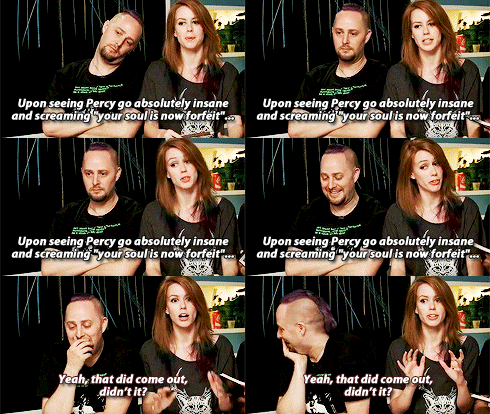
What’s interesting about this origin story is how long Percy presented what was obviously a pact with a demon as “just as dream”, even after his backstory caught up to him – when he started yelling at random NPCs they were fighting “Your soul is forfeit”, being encased in a cloud of smoke, and becoming unusually violent and cruel in battle.
It’s a good example of not metagaming, which is when a player “cheats” by acting on knowledge which they have, but not their characters. Taliesin has been playing D&D for 25 years and is well-versed in fiendish deals with monsters such as shadow demons, but the arrogant rationalist that is Percy basically lived in denial until the voice in his head actually materialized on the battlefield after he refused to kill one of his targets.
Percy wields two guns he has built: one is a monstrous rifle called “Bad News” (because nothing travels faster), but his first gun is a six-shot pistol always referred to by its weapon type, a “pepperbox”. Its name, which I had to look up on the wiki because it’s never said on the show, is “the List”: five of the barrels hold the names of people who are responsible for his family’s death (as can be seen in many pieces of fanart, like the one by David Rodrigues that illustrates the wiki entry): Lord Sylas Briarwood, Lady Delilah Briarwood, Doctor Anna Ripley, Sir Kerrion Stonefell and Professor Anders.
The sixth barrel was blank, and there was a lot of speculation that it was meant for Percy himself – but in episode 34, when his sister Cassandra, alive but essentially brainwashed, betrayed him to stand with the Briarwoods, her name appeared on the last barrel, and this is where he drew the line, and attempted to go back on the original deal with Orthax the Vengeful, the shadow demon.
2) Warlock Flavor
As he was eliminating his first target, Sir Kerrion, in episode 29 however, the Dungeon Master informed him that every time he hit him, he dealt an extra 1d6 of damage. There are a couple spells which have this particular effect, but the most appropriate in terms of flavor is Hex, a Warlock spell. Warlocks draw their magical powers from a pact they make with an otherworldly entity (including though not limited to demons), and tend to be quite dark and beholden to their patron’s goal for them. Again, there was speculation that Taliesin would multiclass into Warlock, but what he did when leveling up in the next episode was take the Magic Initiate feat, which allowed to choose 1 1st-level spell and 2 cantrips from any spellcasting class.
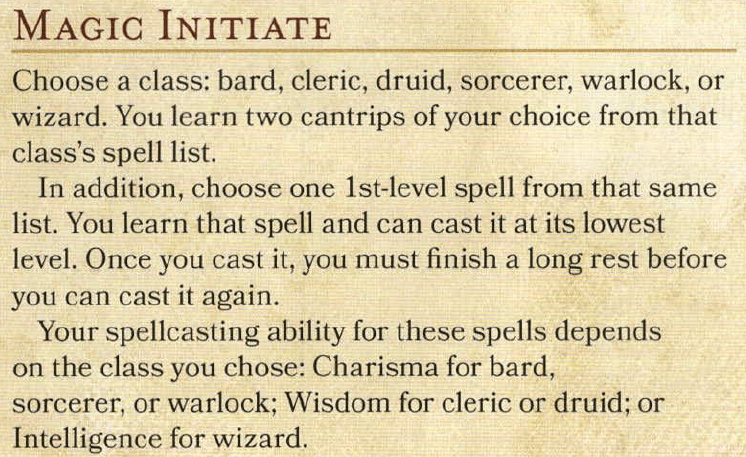
And of course, he chose Warlock so he could get Hex. There’s a type a warlock called Hexblade, where the pact is centered on a weapon gifted by the patron. As was discovered in episode 35 when the gnome bard Scanlan, played by Sam Riegel, threw Percy’s gun into acid and seemingly freed him from his pact, there was a flavor of Hexblade in Orthax’s curse.
3) A Cycle of Vengeance
Critical Role has a talk show called Talks Machina where every Tuesday, they discuss the previous week’s episode, ask fan questions, give prizes for best fanart…and at the end of the first campaign, they did a special 3-hour episode where every question could be answered. Taliesin said that the last barrel was never intended for Percy, that it was instead meant to represent all the innocent people he would hurt in his quest for revenge – it was his knowledge that the list was not the end. And then Matt said that if he had killed his six targets, six more names would have appeared on the barrels. The curse was designed mechanically to be endless, and given how you can’t actually kill most demons on the material plane (they just reform in hell and you have to travel and kill them there), destroying the pact weapon was the only way out of this. Given how Percy had to be magically compelled to give up his gun to Scanlan, it’s quite clear that left to his own devices, he would have been trapped in this cycle of vengeance. Instead, when they fought Orthax again in episode 68, he had attached himself to Ripley, who now wielded a pistol called Animus (according to Merriam-Webster’s definition, this is « a usually prejudiced and often spiteful or malevolent ill will ») with Percy’s name on one of the barrels…
Poetically, the blank last barrel also echoes the blanks which Taliesin left in Percy’s backstory, leaving up to Matt to decide which de Rolos, if any, were still alive, why the Briarwoods took Whitestone, and whether that cloud of smoke was an actual demon or really “just a dream”. A similar cooperation occurred out of necessity for Percy’s class, and yielded results which are just as narratively and symbolically powerful.
II – Checks and Balances: Homebrewing the Gunslinger Archetype
When Critical Role started streaming in March 2015, Vox Machina had already been having adventures in their home game for 2 and a half years, but in the Pathfinder system. The switch to D&D 5th edition impacted everyone, but Percy’s gunslinger is a Pathfinder class with no equivalent in D&D. So this is how he became the inventor of guns in the history of their world, Exandria.
This isn’t about pure creation but about the whole process of balancing to avoid breaking the game with a new element. Continuous adjustment is also how gunslingers work, always on the knife’s edge.
1) Risk and Consequences
Within D&D classes like monk or rogue, there are subclasses, specialties within the classes, like Way of the Drunken Fist for a monk, or Assassin for a Rogue. They are generally chosen at level 3. Percy’s D&D class is fighter, and Matt inserted the gunslinger, his martial archetype, within it.
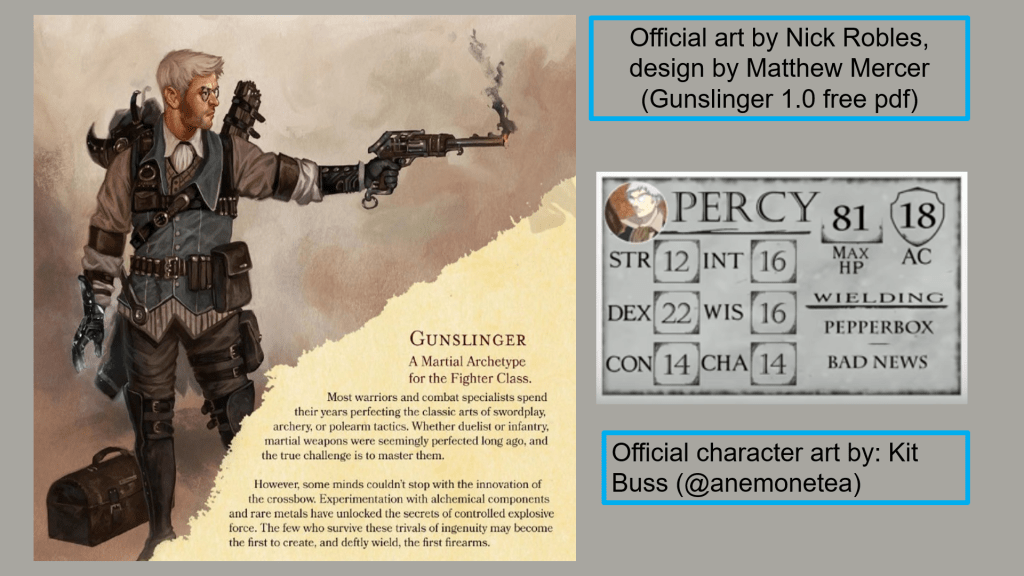
Each class tends to have 1 or 2 stats which are more important than the rest – the charisma of a warlock, for example, determines in part how effective their spells are, their spell-save DC (difficulty class). For everyone wielding weapons but especially fighters, how much damage you do is based on your strength or your dexterity depending on the type of weapon. Guns are finesse weapons, so gunslingers use dexterity. Taliesin managed to raise his DEX beyond the normal 20 maximum with a special magic item – not only for initiative or damage, but also so he could fight at all.
Whenever you roll a d20 in the game, something special happens if you roll a natural 20 or a natural 1 – critical success or critical failure. On a natural 20 for an attack, you double the damage you roll on the dice and sometimes you get to do extra stuff. On a natural 1, you fail, and sometimes there are other nastier consequences. For Percy, every time he rolls a 1 or a 2 while attacking with the List (or a 1, a 2 or a 3 with Bad News), his gun misfires: he doesn’t hit the target, and the gun is jammed. He can use an action to clear his gun, rolling a tinkering check : that’s a d20 roll plus his proficiency bonus (because he is proficient with tinker’s tools), which is +4 at level 11, plus his dexterity modifier + 6.

If he matches or exceeds the difficulty class (10+whatever he rolled for the misfire), the gun is fine. If he fails, the gun is broken and cannot be used for the rest of the battle (although it can be fixed later in his workshop). So gunslingers are people who run the risk of having their weapons blow up in their faces every time they fire. Self-destruction is part of the mechanics of his class archetype and not only of his curse – but that same danger of destruction keeps the gunslinger balanced, simply OP, “over-powered” (which is a compliment), rather than “broken” (which is criticism). And of course, with high risks come high rewards.
2) Paying the Bill
Some classes have a system of points which they can spend to do additional things during their turn: sorcerers have sorcery points, monks have ki points, and gunslingers have grit points. For the others, it’s 1 point per level, but grit points are based on the wisdom modifier. So Percy has a wisdom of 16, that’s 3 grit points which he can use to get advantage on an attack (roll twice, take the higher number, so lesser chance of misfire) or make special shots like wingshot, headshot, forceful shot… Once he has used all 3, he has to take a short rest to get them back, but he also gets 1 grit point back if he kills a target or if he rolls a natural 20.
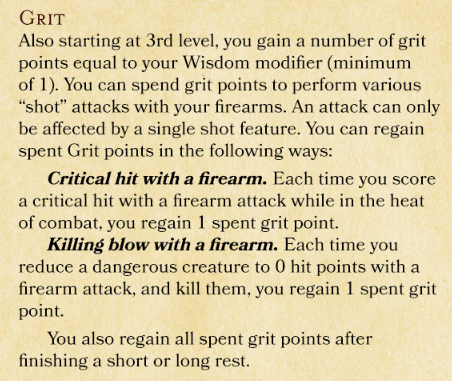
So the gunslinger class is all about numbers, but it’s half strategy and half sheer luck, and again, this mechanical element echoes Percy’s personality and narrative. One archaic meaning of the word “reckoning” is “bill or account, or its settlement”, and while Percy seems prepared to sacrifice innocents for the greater good and/or for his quest for vengeance, he is also at all times keeping a tally of the bad he has done, and is as unforgiving with himself as with the rest of the world. In episode 68, he dies in the battle against Ripley – his companions bring him back to life but while he is dead, they find a letter on him which is basically his last will and testament, and which they read out in episode 69.
It’s quite long, but I’m mostly interested in the end :
As to what must be done, I’d be content to be left in a ditch, my weapons and notes burnt and broken. But I imagine that would upset Cass. If you can, take me home. If you can’t, I understand. She knows where to find the rest of my instructions. Times being what they are, burn my work or bring it home in the hopes of aiding in the defense of Whitestone. I leave this judgment in your capable hands. Please find Ripley before she does too many terrible things, and erase my legacy wherever you find it. That silence would be the greatest eulogy I could ever hope for.
With eternal gratitude, Percival of Vox Machina
Percy’s gunslinger is all about balance, but it’s a very tragic reckoning where the final result has to be null: his life for the lives he took, his memory for the way he damaged the world, his soul in exchange for revenge. No loss, no gain, no chance of redemption – but of course, that’s not what happened, because although Taliesin felt that Percy’s arc was complete, and would have been satisfied to lay him to rest, he left his judgment in the hands of Vox Machina, and they love him.
III – Luck and Love: Beyond #NoMercyPercy
“NoMercyPercy” was the nickname given to him by the fandom in tribute to how OP he was, and it seems to have acted a little like a self-fulfilling prophecy, for better and for worse. However, some key elements of the collaborative story-telling game that is Dungeons & Dragons allowed him to move beyond his revenge quest and, enacted changes which literally saved his soul.
1) Luck of the Dice
So far I’ve been discussing stats from a purely mechanical point of view, but they are also used as a basis for roleplay, to help define a character’s personality, and in that regard, I find it interesting that in later levels, Percy got his Intelligence, which was initially equal to his Wisdom, up to 20. More Wisdom would have meant more grit points, so fewer misfires and more crazy shots in battle, whereas intelligence checks come in when he is designing new things in his workshop – granted they’re mostly things which explode and kill people, but it still feeds into a desire for creation rather than destruction.
On the other hand, I think that not raising Wisdom (which is very good at 16) is also a comment on Taliesin’s part about Percy’s lack of recovery from his trauma. Someone suggested in a reddit thread I really should have bookmarked that Taliesin might have deliberately avoided having more grit to keep Percy balanced, and this was also, in their opinion, why he did not take the Lucky feat, which lets you reroll a d20 roll (for an attack, saving throw or ability check) three times per day.
The funny thing is though that Percy is lucky, so much so that Taliesin coined the expressions “Percy roll” and “I Percy’d again” (C1E33) whenever he rolled a nat20, which was often during the campaign.

That faith in Percy’s luck crystallized on one of his d20s, also known as “the golden snitch”.
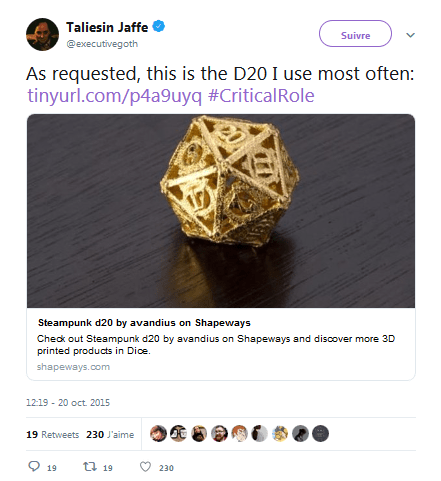
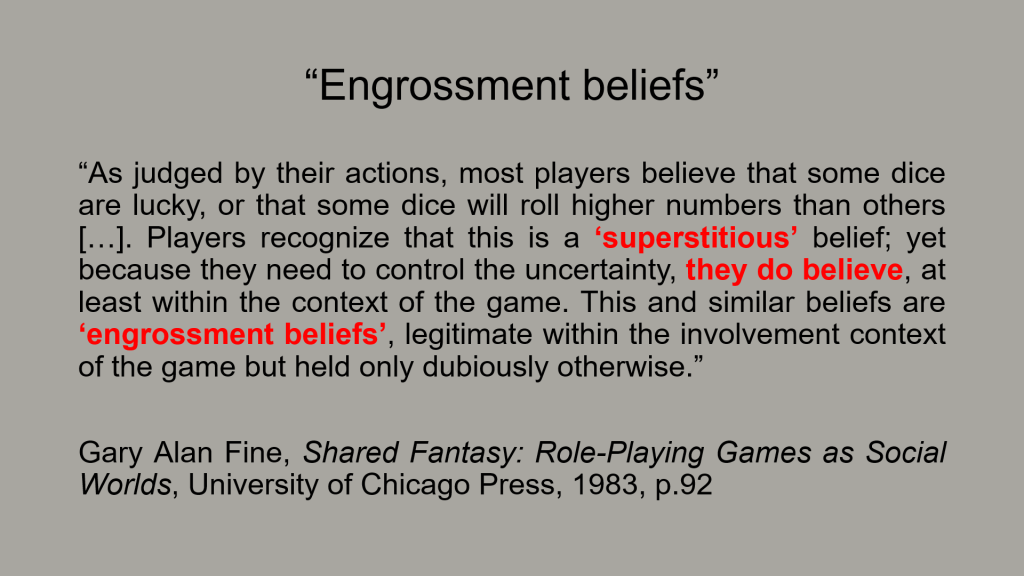
Gary Alan Fine talks about dice as one of the “engrossment beliefs” of D&D, and Critical Role is no exception. Even the two players who are not superstitious, Travis and Liam, believe either in the power of the golden snitch or that Taliesin himself is magic.
Taliesin will say that he rolls no better than anyone else but that people just don’t notice because there is this hero-worship of NoMercyPercy as a ruthless, silvertongued, very lucky bastard.
However, when Critrolestats, an amazing fan-run website, went looking for the most rolled d20 value per player, they concluded: “One quick glance at Taliesin’s natural roll distribution shows that whatever dark deal he made to make the golden snitch amazing paid off. There are no fighter or human features in D&D that would explain away the sudden peak at 20”.

Percy’s golden legend merges with the running jokes about how Taliesin is an immortal vampire, eldritch being or pyramid, and which both he and the fandom certainly play into.

2) Love, Mercy and Wisdom
But you can’t buy back your soul with natural 20s – or can you?
Taking everybody by surprise, Percy told Ripley in episode 68 “Whatever happens today, I forgive you”. Nevertheless, they discovered during the Resurrection ritual that Percy’s soul had been imprisoned in Ripley’s gun, and was being slowly devoured by Orthax. Destroying his List had released, but not saved him from his pact.
Keyleth was able to free his soul with a Greater Restoration spell, which is what technically saved him from hell – though what is most memorable about the resurrection is Vex’ahlia, played by Laura Bailey, finally admitting her feelings to him, and then rolling a natural 20 on her Persuasion check. This is when the term “True Love’s Crit” was coined in the fandom, and one of the moments when, according to Robyn Hope, “that artificial infusion of wisdom into the all-knowing dice takes place” .

Vex, who had been working through her own demons, had carved the word “Forgive” into her bow Fenthras – a weapon marked with the runes “Growth” and “Protection”, but which had become corrupted by its former owner. This is why some people can’t believe that the show isn’t scripted.

Dr. Ripley, who could reason and manipulate with the best of them and believed that the world owed her, was always a much better nemesis for Percy, and a chilling mirror of the kind of monster in human shape he could become. His death and return, however, are more reminiscent of the Briarwoods’ backstory. Matt revealed in the campaign wrap-up that they were a normal(ish) happy couple until Lord Briarwood died of illness. Overcome with grief, Lady Briarwood pledged herself to a dark god so that she would be able to bring back her love as a vampire, and she “broke the world for him”. Percy did not become a vampire, and although love allowed him to return from a metaphorical and actual hell, it was to build a better world.

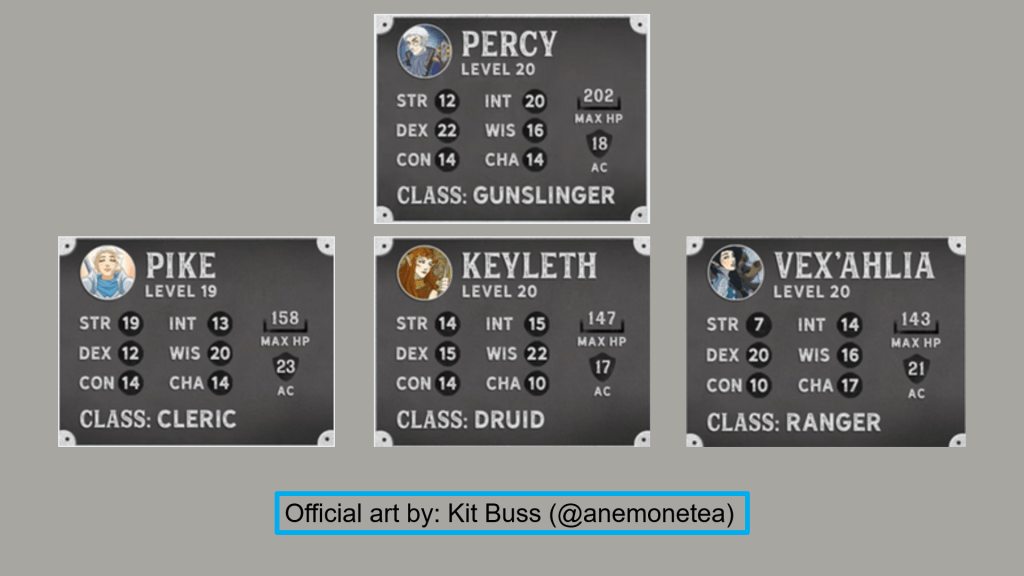
And the three pleas which bring Percy’s soul back from the astral plane are that from his friend Pike and his best friend Keyleth, who often act as his conscience, and Vexahlia, who is his heart. A cleric, a druid and a ranger – three classes which use wisdom for their spells, three women who love him and who are his wisdom.
Conclusion
Percy definitely changed the world by inventing guns, and considered Ripley’s recreation and dissemination of the weapons as his fault. But the biggest change for him was to learn to show mercy, to stop looking towards the past and the vengeance for the family into which he was born, and instead look to the future, to protecting his family of choice and the world into which his children would be born. I know it sounds cliché, but it was a long and painful transformation, furthered and echoed and retooled in all the fanworks produced in this amazing community: there is so much gorgeous fanart and cosplay, excellent fanfic, playlists, a Hamilton musical tribute, and so much more…in the fall of 2020, if all goes according to plan, we should be able to see the Whitestone arc animated as part of the record-breaking Kickstarter which concluded in April 2019.
[The line used for my title “I’m sorry my issues have guns” is from episode 68 (where Percy confronts Ripley), but I ended up showing the panel audience an extract from episode 35 [00:59:20-01:01:41] instead, when Orthax finally materializes, to demonstrate how Critical Role can be both wonderfully dramatic and cathartic and, to quote Matt Mercer again, “a majestic clusterfuck”]
 Draco Ex Academia